Maori’s old phone
Even If This Love Disappears From the World TonightMaori’s old phone is the surviving archive of her relationship with Tooru Kamiya after those around her remove references to him from the records she uses to navigate life with anterograde amnesia. Its photos, videos, messages, and saved sound preserve evidence that the new phone and rewritten journals conceal; later, an audio clip taken from one of its videos gives Maori a sensory route back to a memory of Tooru that she chooses to approach cautiously.
Identity and Contents
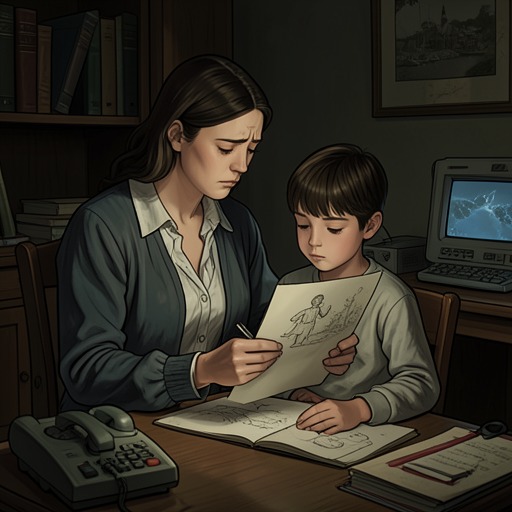
The phone belongs to Maori, whose daily life after an accident depends on written reminders and records of what she cannot retain. Her binder summarizes important information, while her journal records events and feelings; the phone adds a different kind of personal record, storing photos and videos of Tooru and exchanges that connect him to her everyday life. As she reads that she has a boyfriend, she finds a new media folder labeled “My Boyfriend,” filled with photos and videos of Tooru Kamiya. One short video, recorded while they ride a bicycle together, catches the moving twilight scenery and Tooru pedaling ahead as Maori speaks to him. Though she initially regards the footage as a clumsy record of a life she cannot recognize, watching it makes her smile.
That connection between the device and her relationship is not limited to images. The phone also contains messages and text exchanges with Izumi Wataya that refer to Tooru, so the old device gathers both audiovisual traces and the ordinary written texture of their shared life. Its contents are valuable precisely because they are particular records, made in the course of events rather than created later to explain them.
Removal from Maori’s Accessible Records
After Tooru dies, Izumi and Tooru’s sister, Keiko Nishikawa, help carry out the request he had made: remove him from Maori’s journal and binder so that she will not encounter him in the records she reads each day. The plan expands beyond paper. Because Tooru appears in the old phone’s photos, videos, and messages—including exchanges between Maori and Izumi—the group decides that a new phone is needed to remove those traces from Maori’s accessible daily life. Her parents and Tooru’s sister split the cost, and they plan to tell Maori that the old device broke. They also agree to explain missing messages as a failed data transfer.
On the morning of the third day after Tooru’s funeral, Izumi visits Maori’s room while Maori is sleeping in her parents’ room. She takes the old phone, deliberately disrupts the transfer to the replacement device, and registers Maori on a new messaging app, preventing her from seeing past messages that refer to Tooru. The old phone is not discarded, however: Izumi takes it with her and keeps it. This distinction is central to the object’s role. The phone is removed from Maori’s immediate access, but the records it holds remain intact in another person’s care.
A Preserved but Withheld Archive
The decision to keep the old phone makes the attempted erasure incomplete by design. Izumi has promised to carry out Tooru’s request, yet she does not destroy the material that would expose his place in Maori’s past. She keeps the device after replacing it, leaving open a distinction between withholding evidence and eliminating it. The new phone supports the rewritten account of Maori’s life; the old one retains a version that has not been edited to remove Tooru.
The phone’s preservation also exists alongside other acts of record-making and alteration. Keiko offers to transfer Maori’s journal and binder to a computer, removing Tooru while repairing the resulting gaps. Izumi transfers those edited materials, along with entries Keiko has prepared for the days since Tooru’s death, to Maori’s laptop. She also removes drawings of Tooru from Maori’s sketchbooks, while saving the pages separately. Across paper, computer files, sketches, and phone data, the group manages what Maori can encounter, but the old phone remains a physical repository of the photographs, videos, and messages absent from her replacement device.
The Recording and Maori’s Choice
Later, when Maori wonders whether seeing pictures and videos of Tooru might help her remember, Izumi offers access to the old phone. Maori declines. She fears that the images might overwrite the image of Tooru she already has, leaving her able to remember only the version fixed in photographs and videos. Her hesitation gives the phone’s archive a double character: it offers evidence, but access to evidence is not automatically the same as recovering a lived memory.
Izumi suggests a more limited approach: listening to Tooru’s voice. Maori agrees, and Izumi sends her an audio file extracted from a video on the old phone. At first, the recording contains rattling, Maori’s happy squeals, and the sound of wind. Gradually, she recognizes the occasion as the day she insisted that they ride a bicycle together. Tooru’s voice warns her not to lean forward because she could fall; Maori answers that she is fine and calls him a worrywart. When the recording ends, her whole body shakes, and she listens repeatedly in the stillness of the night. The file does not simply report that the relationship existed: its sounds reconnect her to a particular shared moment and to her own joyful voice within it.
Significance
The old phone marks the difference between an erased record and a lost past. Izumi’s intervention deprives Maori of easy access to the digital evidence of Tooru, while preserving the device makes that evidence recoverable in principle. The arrangement is protective but also controlling: friends and family decide what Maori will be able to see, substitute a new account for the old data, and keep the original phone outside her reach. The story makes the cost of that choice concrete without making the phone’s archive a simple solution. Maori fears photographs may constrain rather than restore memory, and the first successful opening comes through a voice recording, heard on terms she accepts.
In this way, the phone connects private memory to its social custodians. Its contents survive because Izumi keeps them; later, she offers a selected recording rather than the entire archive, and Maori decides whether to listen. The device thus holds both the evidence of a relationship hidden from Maori and the means by which she begins to recover it—not by being handed every image at once, but through a carefully chosen sound that lets her recognize a moment as her own.